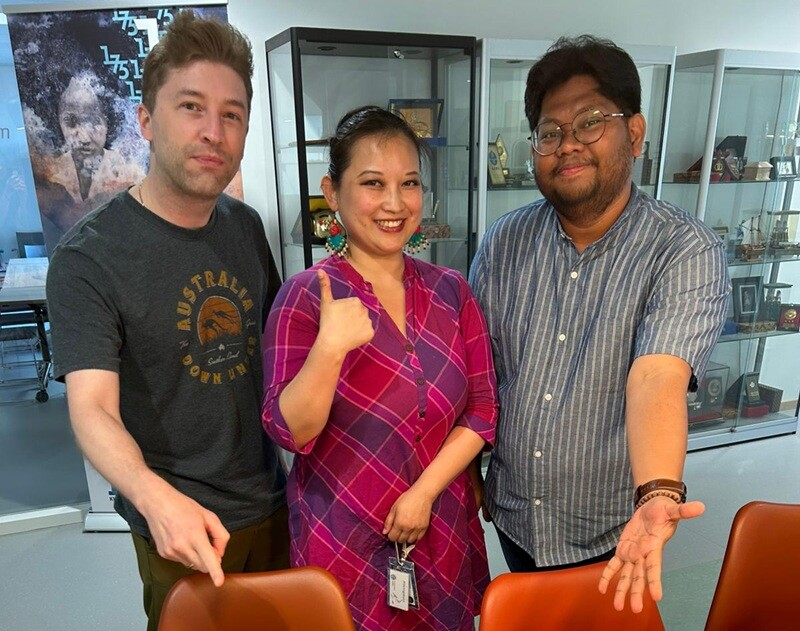
KITLV researchers Tom Hoogervorst (left), Queenie Lin and Louie Buana (right).
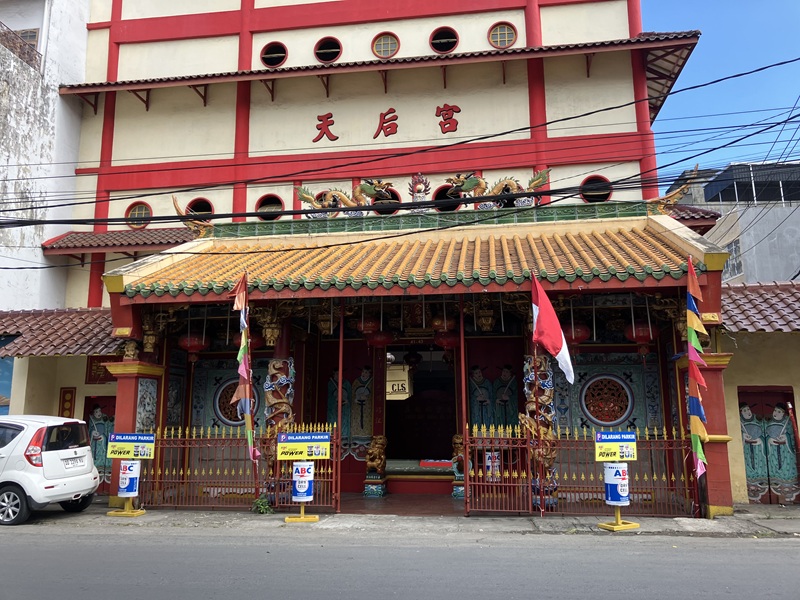
The Mazu temple (the Chinese sea goddess) in Makassar remains the cultural and religious anchor for the Chinese diaspora.
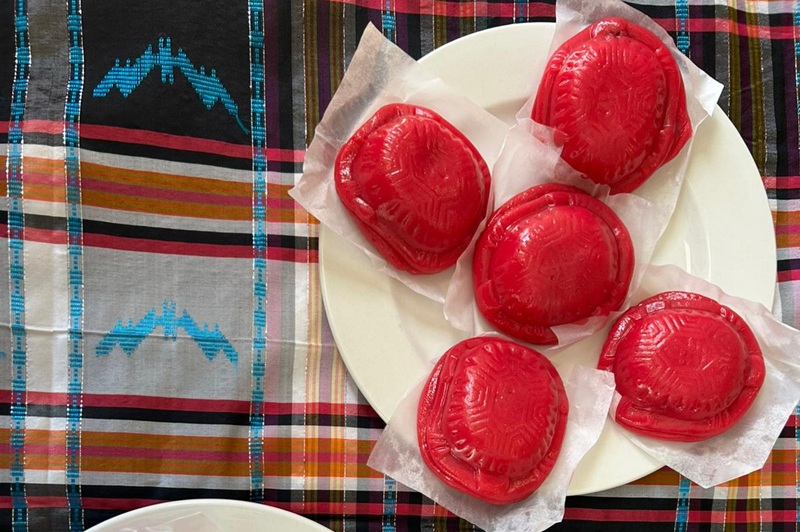
The turtle cakes (紅龜粿/ Ang ku kueh/ kue kura-kura), a typical celebrative food and ritual offerings that signify the shared heritage with diasporic Chinese in Indonesia, Malaysia and beyond, which we will be looking into in the project.
05-06-2026
KITLV researchers Louie Buana, Queenie Lin, and Tom Hoogervorst and two collaborators from Indonesia and Taiwan, Andi Batara Al Isra (Universitas Hasanuddin) and Fabio Yuchung Lee (National Tsing Hua University), have been awarded a € 90,000 grant from the Chiang Ching-kuo Foundation for International Scholarly Exchange (CCKF) for the period 2026–2028.
Their research will examine the Chinese diaspora in Makassar from the VOC era to the present. The research will be focusing on how communities have negotiated social anxiety and vulnerability through religion, storytelling, and food.
Mazu, Hantu, and Kue in Makassar: Shared Heritage and Social Anxieties among the Chinese Diaspora in VOC and post-VOC Asia
This international collaborative project between the Royal Netherlands Institute of Southeast Asian and Caribbean Studies (KITLV), Leiden University, National Tsing Hua University (Taiwan), and Hasanuddin University (Indonesia) investigates how the Chinese diaspora in Makassar transformed social anxiety—understood as a collective emotional and cultural response to colonial governance, racial classification, and spatial segregation—into enduring heritage during the era of the Dutch East India Company (VOC). By situating Makassar within the wider maritime networks of VOC-controlled Asia, the project traces how Chinese migrants, positioned between colonial authorities and indigenous societies, negotiated vulnerability through religion, ritual, storytelling, and food. It aims to reveal how such emotional and creative strategies became the foundation of Makassar’s Chinese heritage and how these practices intersect with those of Taiwan and other Hokkien diasporic worlds.
The project’s main objective is to reconstruct the intertwined histories of religion, folklore, and culinary tradition that shaped the Sino-Makassarese experience. Temples dedicated to Mazu (媽祖), Guanyin (觀音), and Guan Gong (關公) became key sites of protection, social organization, and moral order. These temples not only functioned as spaces of worship but also served as informal arbitration centers, meeting halls, and hubs of mutual aid for the local communities. In parallel, cerita hantu (ghost stories) emerging from Chinese cemeteries circulated as moral allegories about violence, displacement, and unresolved trauma. They reveal how spiritual imagination became a language through which people coped with the instability of colonial life. Meanwhile, culinary traditions such as the making of kue (粿; ritual cakes) and festive foods demonstrate how temple offerings gradually entered the city’s mainstream cuisine, fusing Chinese, Makassarese, and Malay influences. Together, these cultural forms transformed fear and marginality into creativity and belonging, turning the management of anxiety into a collective aesthetic and moral project.
Methodologically, the study integrates archival research, ethnography, and cultural mapping. Archival work will draw from primary and secondary materials in Indonesia (ANRI, Makassar Provincial Archives, and Chinese clan associations), the Netherlands (Leiden University Library, Nationaal Archief), and Taiwan (Academia Sinica, temple and family archives) to reconstruct historical patterns of Chinese migration, settlement, and religious exchange. Ethnographic fieldwork in Makassar will involve site documentation of temples, markets, cemeteries, and ancestral halls through photography, spatial mapping, and interviews with descendants, temple caretakers, and community leaders. By combining historical and ethnographic data, the research will illuminate continuities between VOC-era institutions and contemporary practices, showing how historical memory remains embedded in space, rituals, and cuisine.
A key methodological component of the project is participatory engagement with the local community. In collaboration with the Makassar Chinese Peranakan associations, local historians, and heritage practitioners, the team will organize annual workshops designed to share research findings, collect oral histories, and co-create interpretive materials. These workshops will not only gather community knowledge but also facilitate intergenerational dialogue about cultural continuity and change. These workshops will take place in Makassar, Taiwan, the Netherlands and online to facilitate and encourage comparative reflection and transnational exchange. Public exhibitions accompanying these workshops will feature photographs, stories, and culinary demonstrations, emphasizing that heritage is a living process shaped by both scholars and communities. All collected data—archival sources, spatial documentation, interviews, and visual materials—will be curated into a publicly accessible digital catalogue for knowledge dissemination. These open-access data will be disseminated through academic webpages (KITLV, Leiden, NTHU, etc.) and local networks such as Antropos (Makassar), ensuring open access and long-term preservation. This helps all stakeholders to visualize the interconnections among ritual sites, markets, and maritime routes, allowing users to explore Makassar’s Chinese heritage in relation to Taiwan and the wider South China Sea region.
The project’s significance lies in its interdisciplinary and decolonial approach. By integrating history, anthropology, and cultural heritage, it reframes maritime Southeast Asia not only as a commercial crossroads but as a dynamic emotional and spiritual geography. It challenges Eurocentric views of the VOC world by foregrounding the agency of diasporic Chinese who, through ritual and creativity, turned colonial precarity into cultural permanence. The collaboration between Taiwanese and Indonesian scholars positions the study within the expanding field of Sinophone and South China Sea studies, offering new perspectives on how Hokkien and Hakka diasporas articulated belonging across shifting imperial and ecological boundaries.
Ultimately, this research seeks to build a sustainable bridge between research and community participation, which envisions these materials as open educational resources that can inspire future initiatives—ranging from exhibitions and comic storytelling to digital applications that make local history accessible to younger generations. By highlighting how Chinese migrants in Makassar and Taiwan ritualized fear into faith and turned displacement into creative continuity, this research demonstrates that heritage is not merely about the past—it is an ongoing process of negotiating memory, emotion, and identity across the seas that connect us.