
Events
Southeast Asia Seminar | Dwelling in transition: The intervention of Prabowo-sponsored housing in coastal Jakarta | Wenjing Qiu
Thursday 3 December 2026
Hybrid seminar
It is through patron-client relations that state power penetrates local society. Using an elite-sponsored project in Indonesia as a starting-point, this research shows how patronage becomes part of technopolitics and micropolitics at the community level. Such state interventions extend into rituals and everyday life through unscheduled interactions between powerful elites and community residents, causing a contingent “state effect” that does not solve locals’ subsistence problems but undermines their will to resist land loss.
Before and after the 2024 Indonesian presidential election, the eventual winner, Prabowo Subianto, presented a quick-fix solution for the coastal communities in Jakarta that were facing severe tidal flooding: “Rumah Apung dan Rumah Panggung (Floating Houses and Stilt Houses)”. This housing project entailed demolishing some of the fisher people’s houses and building new stilt houses on the same site. Prabowo’s military representatives from the Indonesia Defense University actively engaged in surveillance of this process. Paradoxically, the impact of the construction of the new stilt houses has especially been to change the property rights of local households.
This project thus works not only as a technocratic showcase but also as what many suspect is the precursor to a land grab. Facing intense pressure on valuable waterfront land, residents are caught between the contested National Capital Integrated Coastal Development (NCICD) mega-project and commercial real estate speculation. This elite intervention extends well beyond a single neighborhood, destabilizing marginalized coastal kampungs across the region. By entangling residents in patron-client relationships with a top political figure, the housing project has alienated them from the majority of the coastal settlements resisting land loss. The political drama of land does not end; with the restart of the NCICD project, Coastal Jakarta’s future remains uncertain.
Speaker
Wenjing Qiu is a PhD candidate at the Institute for Area Studies. Her research interests include Indonesian kampungs, mapping practices, social movements, the urban history of Indonesia, and the historical and contemporary relationship between the Netherlands and Indonesia in the field of urban planning.
Discussant
Ward Berenschot is a professor of comparative political anthropology at the University of Amsterdam and a senior researcher at KITLV. Studying politics in India and Indonesia, his research focuses on the role of money and informality in election campaigns, while a second field of research concerns the character of civil society and citizenship in these countries.
Moderator
David Kloos is a historian and anthropologist with a focus on Southeast Asia (particularly Indonesia and Malaysia), working as a senior researcher at KITLV. His main interests are religion (particularly Islam), gender, the politics of knowledge formation, visual methods, and the study of the social, political, and cultural aspects of climate change.
Format, date, time & venue
This seminar is a hybrid event and will be held in the conference room of KITLV, Herta Mohr building, room 1.30, Witte Singel 27 A, Leiden and online via Zoom, on Thursday 3 December from 15.30–17.00 PM (CET).
Image
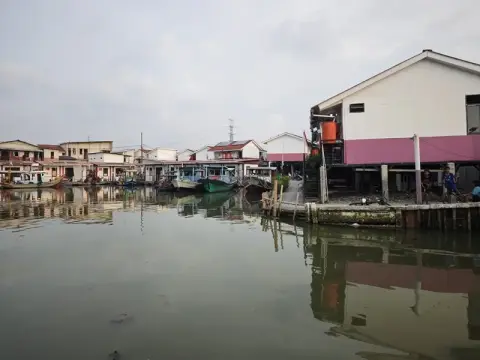
New houses have changed the landscape of this shell-processing kampung, stilted on steel piles or floating along the bank. Photo by Wenjing Qiu, 8 May 2025.
Flyer
PDF version
Details
Date
Thursday 3 December 2026
Time
15.30-17.00 PM (CET)
Location
KITLV, Herta Mohr building, room 1.30, Witte Singel 27 A, Leiden and online via Zoom.
Category
Hybrid seminar
Organizer

Ward Berenschot
