
Events
Southeast Asia seminar | Imagining Javan tigers: Ghost, monster, siluman | Tito Ambyo
Thursday 29 October 2026
Hybrid seminar
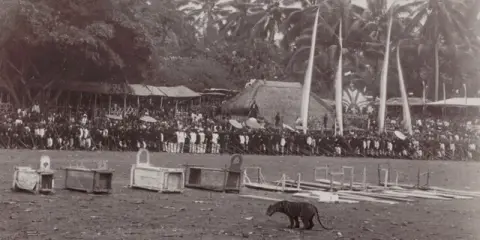
In a late-nineteenth-century photograph from Java, a tiger just released from its crate walks across an arena ringed by men with spears. It is a rampog macan, a ritual tiger-killing staged by Javanese regents, often with Dutch officials watching. The Javan tiger was not yet extinct, but its ending was already under way.
More than a century later, decades after the last confirmed sighting and its listing as extinct by the International Union for Conservation of Nature (IUCN), tigers keep returning to Java as statues, memes, literary characters, mascots and spirits. In 2017, for example, the army demolished a tiger statue in Cisewu, West Java, after it went viral as a national joke. At the end of 2025, villagers in Kediri, East Java, chose instead to keep their own mocked white tiger statue, which has since become a tourist attraction. Meanwhile, as I camped in a forest in Aceh in 2026, a guide whispered to me that a young male Sumatran tiger, from a critically endangered population, was roaming nearby in search of territory of his own.
Presented midway through Tito Ambyo's KITLV fellowship as work in progress, this talk asks what it means to care for an animal that is gone but keeps returning. Recent work in the environmental humanities reads such presences as ghosts, traces of lost ways of life, or as monsters, figures of entanglement and threat. In Java, relations with tigers suggest a third mode: the siluman, neither ghost nor monster yet both, a being that persists by changing form. Ambyo approaches the tigers through hantulogi, a method developed from my research on Indonesian ghost-content creators on YouTube, which reads archives, photographs, social media and ethnographic encounters alongside one another and holds claims about the unseen in the stance of percaya engga percaya, “believe it or not”. Reading photographs and tiger skins held in Dutch collections alongside statues, memes and stories from the forest, Ambyo asks what care might look like for remains kept far from where they lived, and for a tiger that survives as a spirit, a joke and a name.
Speaker
Tito Ambyo is a media anthropologist, journalist and lecturer at the School of Media and Communication at RMIT University in Melbourne, Australia, and a member of the History, Memory and Decolonial Futures collective at the University of Melbourne. His research focuses on haunting, ecology, memory and media in Southeast Asia and Australia. At KITLV, he is researching the haunting of extinct animals, taking the Javan tiger as his central case.
Moderator
Hatib Kadir is an environmental humanities researcher specializing in ecological crises in peripheral regions at KITLV. Over the past seven years, he has conducted research in coastal areas of the Eastern Indonesian archipelago, spanning from Maluku to West Papua. His work delves into the intersections of the Anthropocene, human and non-human interactions, and ecological disruptions caused by resource exploitation, infrastructure projects, political policies, human activities, settler colonialism, and invasive species.
Format, date, time & venue
This seminar is a hybrid event and will be held in the conference room of KITLV, Herta Mohr building, room 1.30, Witte Singel 27 A, Leiden and online via Zoom, on Thursday 29 October from 15.30–17.00 PM (CET).
Image
Rampog macan. Source: Wereldmuseum.
Flyer
Details
Date
Thursday 29 October 2026
Time
15.30-17.00 PM (CET)
Location
KITLV, Herta Mohr building, room 1.30, Witte Singel 27 A, Leiden and online via Zoom.
Category
Hybrid seminar
Organizer
