12-09-2026
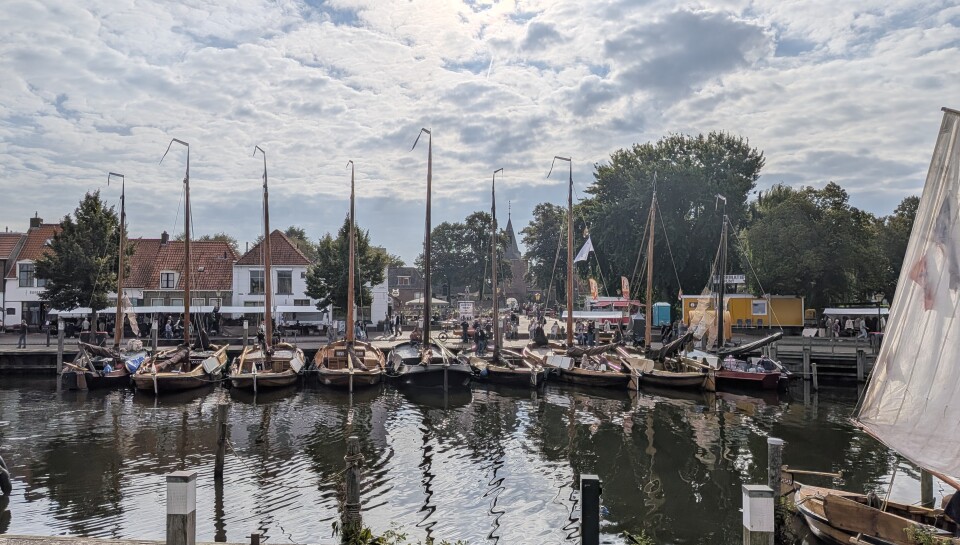
Botterdagen (Boat) Festival in Elburg
TRACE PhD Researcher Altan I. Ishmael's reflection after visiting Botterdagen (Boat) Festival in Elburg with the TRACE Team.
What happens to the knowledge of the sea when the people who know how to read it are no longer there?
This question stayed with me long after leaving Elburg.
I began thinking about it during my visit to the Botterdagen (Boat) Festival in Elburg, a historic former fishing town in Gelderland, the Netherlands, on Saturday, September 12, 2026, with the TRACE Team of KITLV. The festival brought together traditional boats, music, food, historic buildings, crafts, fishing traditions, and stories of a maritime town shaped for centuries by its relationship with water. Its 2026 theme, Veerkrachtig Erfgoed, or “Resilient Heritage,” felt particularly appropriate.
What I encountered was not simply a celebration of the past. It was a place where people were actively negotiating what should be remembered, how it should be passed on, and who might carry it forward.
When I entered the boatbuilding and boat-maintenance area, the smell of wood, tools, water, and the materials of working boats immediately reminded me of someone special. The recognition was sudden and unexpected. For a moment, the distance between the Netherlands and Tawi-Tawi seemed to narrow.
I was standing in a different maritime world, surrounded by different boats, histories, and institutions, yet something familiar brought me back through memory.
It was the smell of my father.
My father loved the sea and fishing. He built his own boat, which he called Batik, named after the constellation Orion, which he associated with navigating the sea at night. He passed away in 2013.
The smell was not simply a reminder of him. It made me think about how much of a person’s knowledge and presence can remain in the memories of those who survive them.
A person disappears, but portions of their presence can remain in places, objects, practices, sounds, and sensations. This made me think about maritime heritage differently. Heritage does not live only in museum labels, archival documents, monuments, or academic publications. It can also reside in smell, touch, sound, movement, bodily memory, and the practical knowledge of people who have spent their lives around water.
My father’s Batik was more than a boat. It was part of a maritime life. Thinking about it in Elburg reminded me that boats can carry not only people and goods, but also knowledge, memory, identity, and relationships with the sea.
We continued to explore the museums, exhibitions, and different activities across the festival. Moving through these spaces, we encountered boats, historical objects, photographs, stories, music, and people involved in keeping Elburg’s maritime heritage visible.
But we also wanted to look beyond preserved objects and exhibitions and learn more about the people and practices connected to the sea today.
We were looking for fishermen to learn more about their maritime practices, but we did not have conversations with fishermen themselves. Instead, we had the opportunity to speak with the crew of the boat we hired for sailing during the festival. Their stories and explanations gave us a glimpse into the practical and embodied nature of maritime knowledge.
What struck us was how much the crew’s knowledge was grounded in participation. They spoke about reading the wind, understanding the water, and responding to changing conditions at sea.
From these conversations, we began to see how maritime knowledge is embedded in everyday practices and relationships. The boat was not simply a means of moving across the water; it was also a space where knowledge was practiced and shared. The crew’s explanations showed us how reading the wind, understanding the water, and responding to changing conditions are skills developed through experience, observation, and participation.
That simple phrase stayed with me: “to read the wind.”
It is more than simply observing the weather. It means developing a practical sensitivity to signs and changes that become meaningful through repeated experience. Such knowledge is difficult to separate from the body of the person who carries it. It is learned through doing, watching, listening, remembering, and accompanying those who already know.
It is knowledge acquired not primarily from a textbook, but through sustained participation in a particular environment and community.
This is why the loss of fishermen can mean more than the disappearance of an occupation. It can also mean the disappearance of a particular way of knowing.
This became even clearer inside Elburg’s former fish auction, the Visafslag. The building opened as a municipal fish auction in June 1916 and continued operating until the decline of Elburg’s fishing economy following the transformation of the former Zuiderzee. Today, the building preserves the memory of that world, including its historic auction clock.
The clock was not simply an old machine. It was once part of a social system linking fishermen and fishmongers. Fishermen brought the catch. Fishmongers competed for it. The clock organized the exchange. The building gave that relationship a physical place.
What struck me was how much social knowledge was embedded in what could easily appear to be an ordinary historical object. To understand the clock, one needs to understand the people who used it, the fish they brought, the traders who bought it, the rhythms of fishing, and the economic world that surrounded the harbor.
A museum object, in this sense, is never only an object. It can be an entry point into an entire social world.
The transformation of the Zuiderzee through the Afsluitdijk and the subsequent creation of Oostelijk Flevoland changed the ecological and economic conditions upon which Elburg’s fishing depended. The consequences were not simply environmental. They were also social and cultural.
An occupation disappeared. A working landscape changed. A body of knowledge became less necessary in everyday life. Eventually, a fish auction became a museum.
This history complicates the idea of heritage. Heritage is often presented as something that remains after change has already happened. But Elburg suggests something more difficult: heritage is also what people struggle to preserve when the conditions that produced it no longer exist.
One of the people who made this question especially visible to me was Gerjan Ruijter.
Gerjan is a younger heritage bearer in Elburg: a volunteer, guide, and auctioneer at the Visafslag, and someone deeply involved in communicating the town’s cultural history. His connection to this history is also personal. His maternal grandfather, known as Opa Gerrit, was among Elburg’s last fishermen.
Gerjan did not simply tell us historical facts. He animated them. He explained the fish auction and its descending clock and shared stories about Elburg’s changing relationship with water and the experiences associated with the old harbor landscape. Through his stories, the past became less like a distant chronology and more like something inhabited by people.
His role is important precisely because he belongs to a different generation from many of the people whose memories he helps preserve. He is not simply remembering. He is participating in the work of remembering.
Heritage transmission does not necessarily mean that one generation reproduces another generation exactly. It can mean that younger people select, interpret, translate, and re-present inherited knowledge for new audiences.
Gerjan’s work therefore raises another question: What does it mean to inherit a maritime world that you did not personally live?
This question became particularly visible when we encountered school groups visiting the Visafslag. These children were encountering a maritime history they had not experienced themselves.
Their presence reminded me that heritage transmission is not simply about preserving information. It is also about giving younger generations opportunities to encounter places, objects, stories, and practices, and to understand the relationships between people, livelihoods, and the environments that shaped them.
The question is not simply whether children can memorize the history of fishing. It is whether they can understand why that history mattered: what the harbor meant to a family, what a boat meant to a livelihood, what it meant to know the wind, what was lost when fishing disappeared, and what remains when the occupation itself is gone.
Walking through Elburg during Botterdagen, I found myself thinking about the town as a living archive. The boats were archives. The former fish auction was an archive. The harbor was an archive.
Even the skills involved in maintaining a wooden boat carried traces of another time.
The festival itself extended this archive into the present. The boats were not merely displayed; people worked with them, sailed them, explained them, maintained them, and told stories about them. The festival showed that heritage can coexist with contemporary cultural production rather than existing only as something preserved behind glass.
This matters because living heritage cannot survive by being frozen.
A boat that is never maintained eventually decays. A song that is never sung disappears from memory. A fishing practice that is never practiced becomes description. A story that is never retold becomes an archive entry. Heritage therefore requires work.
As a Sama from Tawi-Tawi, I could not encounter Elburg’s maritime history as a detached observer. My own intellectual and cultural standpoint shaped what I noticed.
In Tawi-Tawi, knowledge of the sea has also historically involved reading winds, currents, tides, seasons, stars, and other environmental signs. Within Sama communities, concepts such as papata point toward forms of knowledge developed through sustained engagement with the maritime environment.
Yet I do not see Elburg and Tawi-Tawi as the same.
Their histories, political contexts, technologies, ecologies, economies, and forms of territorial organization are different. The value of comparison lies precisely in recognizing those differences while asking what they allow us to see about maritime knowledge more broadly.
What Elburg helped me recognize is that maritime knowledge is not simply a collection of facts about the environment. It is relational, learned through practice, embedded in social relationships, and dependent on opportunities for transmission.
Once the social world that sustains a form of knowledge changes, the knowledge itself can become vulnerable—even when museums, festivals, photographs, and archives continue to preserve fragments of it.
This brings me back to the question with which I began: What remains when the fishermen are gone?
In Elburg, much remains. There are boats. There is the Visafslag. There is the auction clock. There are photographs, documents, songs, monuments, festivals, and museums. There are schoolchildren learning about the fishing past. There are older people carrying memories. And there are younger people like Gerjan who have taken on the difficult work of keeping those memories intelligible.
But preservation is not the same as continuity.
A museum can preserve a boat, but it cannot automatically preserve the world that once gave the boat meaning. An auction clock can continue to function, but it cannot recreate the economic relationships that once surrounded it. A song can survive, but its social context may change. A story can be retold, but each retelling also changes the relationship between past and present.
Perhaps this is what resilient heritage can mean: not that the past remains untouched, but that people continue to find ways to carry something forward after the conditions that produced it have changed.
When I left Elburg, I kept returning to the smell of the boatbuilding and boat-maintenance area and the memory of my father. That moment helped me understand something that historical documents alone could not have shown me.
When a person dies, their knowledge does not necessarily disappear at the same moment. It can remain in the memories of others, in the practices they taught, in the objects they handled, and in the stories people continue to tell.
But memory is fragile.
Without transmission, even the most deeply lived knowledge can eventually become difficult to recover.
For me, Elburg offered neither a mirror nor a simple comparison. It offered a question:
What happens when knowledge remains after the livelihood that produced it has disappeared?
Perhaps the answer is not simply preservation. Perhaps the real task is transmission.
To keep knowledge alive, someone must still be willing to listen, ask questions, teach, and remember.
And someone, eventually, must remember the rememberers.
That is what I carried with me from Elburg: not only the image of wooden boats on the harbor, the sound of maritime songs, or the movement of the auction clock, but the recognition that the most fragile part of maritime heritage may not be the boats at all.
It may be the human capacity to read the sea. And to pass that knowledge on before the last reader is gone.