04-08-2026
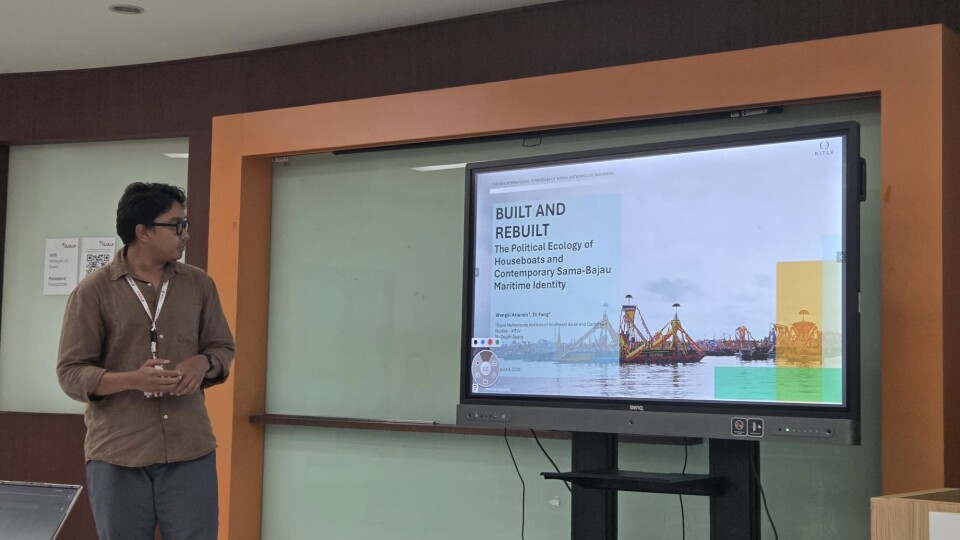
Wengki Ariando presents TRACE project at the 9th International Symposium of Jurnal Antropologi Indonesia.
TRACE team member Wengki Ariando and co-author Di Fang recently presented their collaborative research at the 9th International Symposium of Jurnal Antropologi Indonesia (ISJAI 9), hosted by the University of Indonesia in Depok.
Their presentation, titled "Built and Rebuilt: The Political Ecology of Houseboats and Contemporary Sama-Bajau Maritime Identity," was featured in the panel "Perahu, Sailors, and Sailing Traditions in Indonesia: Socio-Cultural Dynamics, Challenges, and Future Pathways". Notably, this work incorporates an interdisciplinary approach, integrating academic research with artistic collaboration to explore the socio-cultural dynamics of sea nomads.
Abstract
This research examines the evolving maritime identity of the Sama-Bajau through two houseboat traditions: the Lepa of Semporna, Malaysia, and the Soppe’ of Wakatobi, Indonesia. These houseboats are not merely architectural structures; they are vital spaces reflecting the Sama-Bajau’s identity, culture, ecology, and connecting past, present and future. However, as the Sama-Bajau become increasingly sedentary, these houseboats have begun to decline. In Semporna, the Lepa has transformed from a functional family dwelling into a vibrant symbol of political visibility. When the state seeks to remove the community from a territory, authorities often burn the Lepa to eliminate their mobility. On the other hand, through the spectacle of the Regatta Lepa festival, we explore how this houseboat serves as a platform for the Sama-Bajau to assert their presence. For a community often grappling with statelessness and a lack of formal recognition, this annual decorated boat competition becomes a crucial, albeit complex, tool for negotiating citizenship and belonging. However, the Regatta Lepa is frequently influenced by external political and private agendas, turning a heritage icon into a site of modern contestation. Then, the Soppe’ of Wakatobi shows a quieter story of loss. Once central to nomadic life, this houseboat is fading toward extinction. When it does appear in multi-cultural festivals, it is often reduced to a decorated shell powered by an engine. Our work highlights how the pressure to modernize, the shift toward motorization, and the enforcement of stricter timber regulations under the guise of conservation have turned the Soppe’ into a relic of the past. This struggle is both ecological and social; as the boat fades away, so does the societal acceptance of a lifestyle that refuses to be bound to the land. By juxtaposing these two cases, we highlight the duality of the contemporary Sama-Bajau experience. While one houseboat is celebrated as a monument to gain political leverage, the other quietly erodes amid environmental and social change. This research argues that Sama-Bajau identity is a fluid and ongoing construction—"built and rebuilt" at the intersection of cultural pride, political necessity, and the raw challenges of environmental survival.
Further Details: The ISJAI 9 portal