01-09-2026
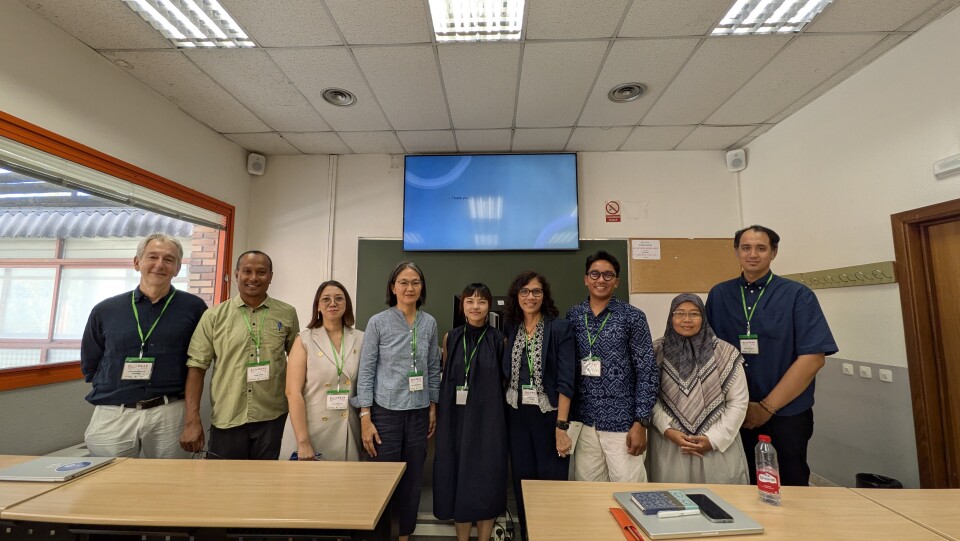
The TRACE panel conveners and presenters at EuroSEAS 2026
TRACE organized a double panel titled “Tracing knowledge-scapes for grassroots climate governance in Southeast Asia” at the 14th European Association for Southeast Asian Studies (EuroSEAS) conference.
Co-convened by Diana Suhardiman and Hatib Kadir, the sessions brought together nine presenters to share their research and insights. The panels featured diverse case studies spanning six countries across the region: Thailand, Indonesia, the Philippines, Malaysia, Myanmar, and Laos.
Panel abstract:
Climate change is unfolding with levels of extremity that are unparalleled in human history. Widespread forest fires due to severe droughts as well as massive floods caused by torrential rains and extreme storms have led to catastrophic socio-economic loss. Building on the relational turn in socio-ecological system thinking, the panels positions place-based knowledge systems, the so-called knowledge-scapes as key building blocks in grassroots climate governance, and how the latter could contribute to breaking the current deadlock in global climate adaptation. Debunking the conceptual separation of nature and society and moving beyond expert ontologies, grassroots climate governance is rooted in interrelated ontologies of knowledge, culture, and agency. It investigates how knowledge (re)production processes are rooted in and derived from symbiotic relations (or the lack thereof) between the different types and forms of knowledge, local institutional rules, arrangements, and practices, and the power dynamics that shape it. Which evolutionary pathways, actors, and symbiotic relations, connect various place-based knowledge systems and past knowledge (re)production processes (including through historical and inter-generational understanding) with present and future adaptation strategies? Which institutions, local institutional rules, arrangements, and practices serve as culturally continuous and discontinuous institutional foundation (re)shaping climate adaptation practices over time? Which forces and conditions shape types of agency and political spaces of engagement that are crucial for the creation, sustenance, and reproduction of locally nested inter-scalar adaptive networks?
For more details about the sessions and presenters, please visit the EuroSEAS 2026 Panel Page.