27-08-2026
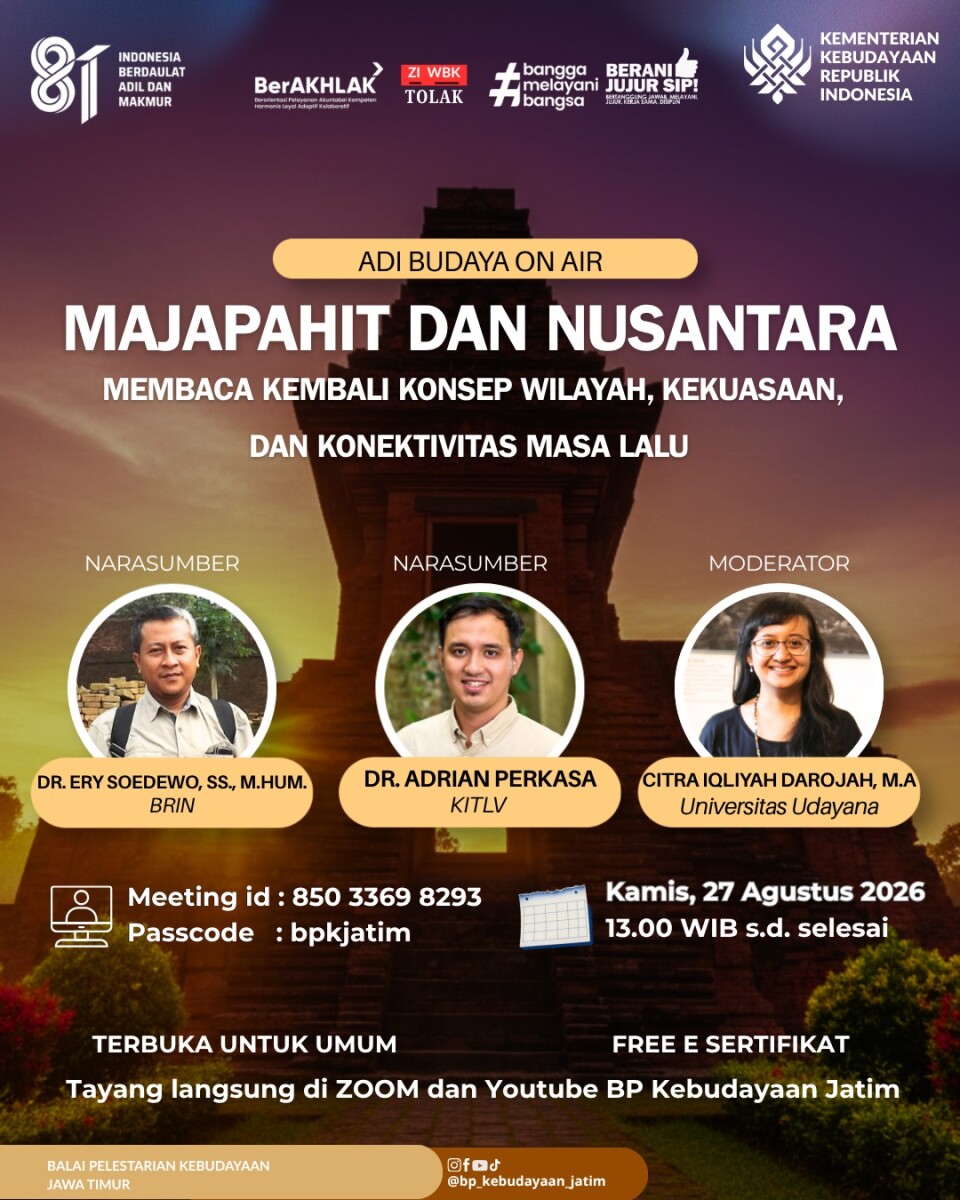
TRACE team member Adrian Perkasa gave a talk at a special webinar hosted by the Cultural Heritage Preservation Center (Balai Pelestarian Kebudayaan) of East Java.
The broader event, titled "Majapahit dan Nusantara: Membaca Kembali Konsep Wilayah, Kekuasaan, dan Konektivitas Masa Lalu" (Majapahit and Nusantara: Rereading Concepts of Territory, Power, and Past Connectivity), aimed to re-examine historical dynamics across the region.
During the session, Adrian Perkasa delivered a presentation in Bahasa Indonesia titled "Does the Maja Taste Bitter? Exploring the Ecological History of Indonesia During the Majapahit Era." His talk provided a unique environmental lens on one of Southeast Asia's most prominent historical empires, shedding light on how ecological factors intersected with regional power and society.
Abstract:
This talk offers an explanatory discussion grounded in my long-term engagement with Majapahit history and Trowulan, the site believed to be the kingdom’s ancient capital. Majapahit, a prominent Southeast Asian kingdom, derives its name from the Maja fruit (Aegle marmelos sp.), often described as bitter. Yet, the fruit is actually sweet and sour when eaten raw. Today, in Trowulan, local and national governments plant what they believe to be Maja trees around the museum and archaeological sites, however, these are actually Crescentia cujete, a species likely introduced from Latin America after the Columbian exchange, long after Majapahit’s decline. In this talk, I explore how ecological histories and the movement of species across the world’s oceans, especially prior to and during the Columbian exchange, have shaped not only botanical landscapes but also local identities and heritage narratives. By employing an ecological and transregional perspective, this research seeks to move beyond nation-centered histories of Majapahit. Instead, it traces more-than-human circulations across regions.