02-06-2026
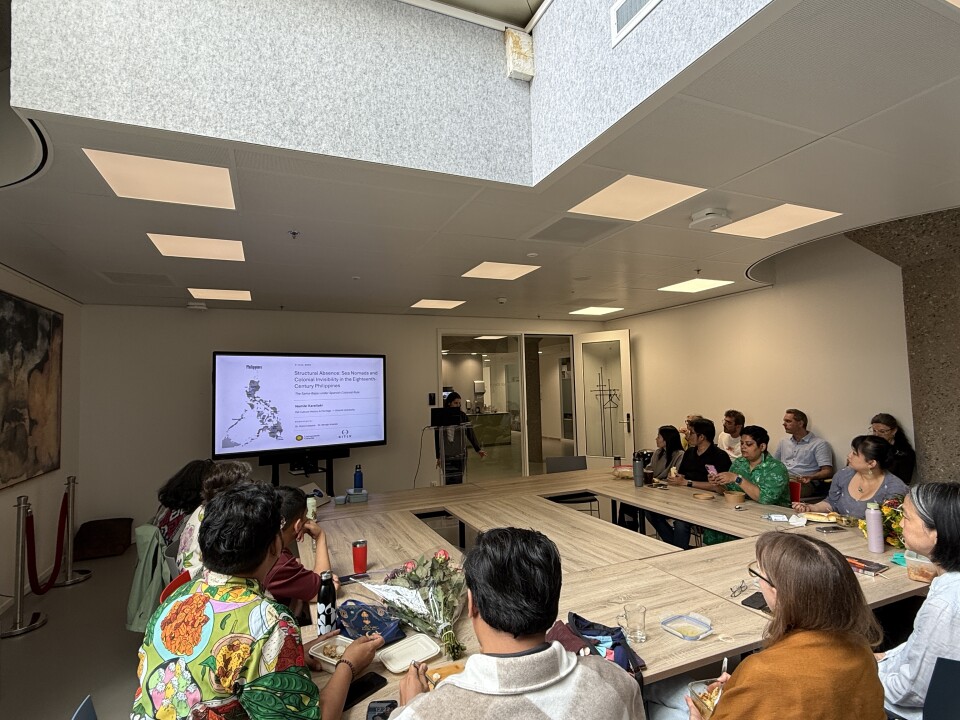
Ms. Nomiki Karelaki presents her M.A. and intership work at KITLV
Ms. Nomiki Karellaki, a TRACE intern and M.A. student in Cultural History and Heritage at Utrecht University, recently delivered her final presentation. This internship also served as her final M.A. thesis, supervised by TRACE team member Wengki Ariando.
Nomiki’s research focuses on the representation of the Sama-Bajau sea nomads in 18th-century Spanish colonial maps. Her thesis is titled: "Structural Absence: Sea Nomads and Colonial Invisibility in the Eighteenth-Century Philippines, The Sama-Bajau under Spanish Colonial Rule."
Abstract:
The Sama-Bajau represent as a maritime and often nomadic community found across the Sulu Archipelago and the coastal regions of maritime Southeast Asia. However, Sama-Bajau are almost entirely absent from Spanish colonial records of the eighteenth-century Philippines. This thesis asks why this absence existed. Drawing on Foucault’s concept of power/knowledge, Maier’s theory of territorialization and postcolonial approaches as synthesized by Gunn, it argues that this absence was structural. In other words, it was not simply the result of accident or lack of information but a consequence of the incompatibility between the Sama-Bajau’s mobility, maritime-based way of life and the administrative, religious and cartographic systems through which Spanish colonial governance sought to classify, map, and govern the populations of the southern Philippines. Through the analysis of colonial archival sources, missionary accounts and five cartographic documents, this thesis argues that systems of colonial control, religious conversion, economic extraction and territorial administration shared a common limitation: they were designed primarily around fixed, settled and classifiable populations which made mobile maritime communities such as the Sama-Bajau difficult to register as distinct colonial subjects. The cartographic analysis further suggests that their absence from Spanish colonial maps cannot be explained solely as a consequence of geographic ignorance. This pattern points instead to the selective priorities and classificatory limits of colonial cartography, as demonstrated through the counter-example of the Buginese nautical chart. This thesis introduces the concept of structural absence as an analytical framework that can be applied beyond the Sama-Bajau case to other mobile and non-sedentary communities whose histories have been made invisible by colonial administrative systems based on fixed settlement and territorial control.