20-10-2026
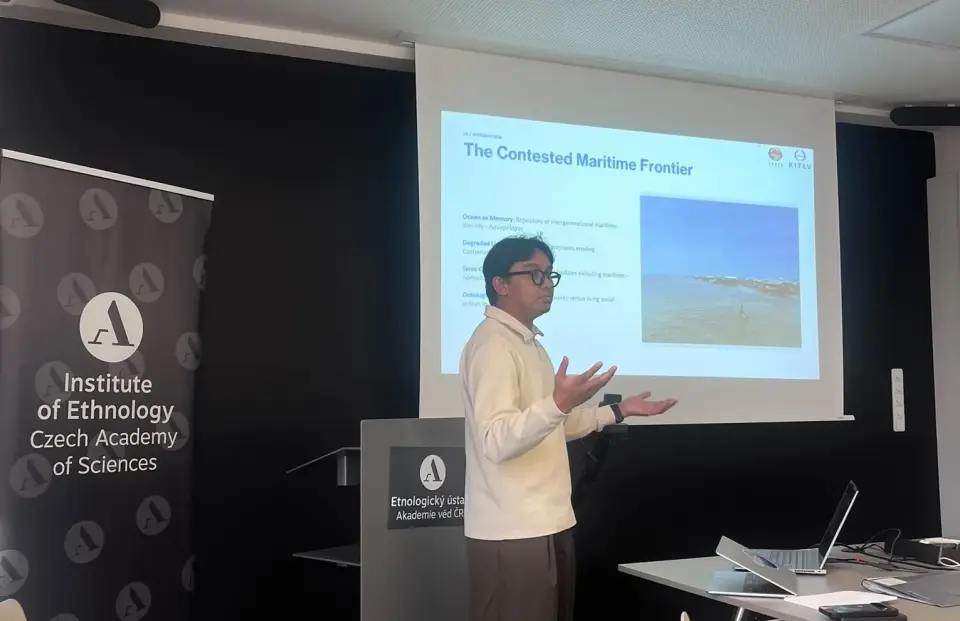
Wengki Ariando presents his research at the Institute of Ethnology at the Czech Academy of Sciences
Wengki Ariando, a Postdoctoral Researcher for the TRACE project, recently presented his latest research at an international academic writing workshop titled “Food, Nourishment, and Metabolic Justice in the Extractive Frontiers.”
Held in Prague, Czech Republic, from October 20 to 23, 2026, the event was organized through a collaborative effort between the Institute of Ethnology at the Czech Academy of Sciences and KITLV.
The primary focus of the workshop was to critically reflect on how extractive activities shape, constitute, and transform the multifaceted dimensions of nourishment. Scholars gathered to discuss how human identity, multispecies relations, cultural values, kinship, beliefs, politics, history, and technologies are all profoundly impacted by expanding extractive frontiers globally.
Within this critical framework, Wengki Ariando presented his TRACE compelling paper entitled, “Nyambalah as More-than-Human Entanglements and the Struggle of the Sama-Bajau Sea Nomads for the Fluid Domain.” Grounded in his extensive fieldwork in Indonesia's Wakatobi National Park, his research explores Nyambalah—a highly specialized traditional tuna-fishing method practiced by the Sama-Bajau people. Wengki Ariando detailed how this practice relies on an intricate, non-human relational network that intimately involves birds, dolphins, whale sharks, sharks, and schooling small fish to locate and harvest tuna.
During his presentation, Ariando emphasized that Nyambalah represents far more than a mere fishing technique; it manifests as a deeply lived marine spatial ethnography and a highly sustainable ecological practice. The Sama-Bajau navigate fluid geographies that transcend rigid horizontal and vertical boundaries, guided not only by animate marine actors but also by inanimate environmental forces such as winds, ocean currents, sea temperatures, and seasonal monsoon cycles. Together, these elements define what Ariando describes as the "triadic assemblage of Nyambalah ontology."
Examining this through the theoretical lens of metabolic (in)justice, the research highlights a stark conflict. While Nyambalah operates as a vital socio-ecological food web that has historically sustained Sama-Bajau livelihoods, it is increasingly under threat. The practice is actively being co-opted by global market economies and capitalist fishery systems that systematically devalue these delicate, interspecies relationships. Furthermore, Ariando argued that within the context of fluid marine territories, the traditional practices of the Sama-Bajau are being increasingly marginalized and restricted by the rigid spatial enclosures imposed by modern marine protected areas.
The rich insights and theoretical frameworks developed during this intensive writing workshop will be taken forward as actionable academic outputs. Ariando's work, alongside the contributions of his fellow presenters, will be developed into a collaborative publication designed to advance global anthropological and ecological discourse.